
WALLFLOWER CATALOGUE FILE.036 Nario Hoshino & Fumika Yoneyama - Matsumoto Retro Architecture Stroll
Winter 2022: A Trip to Matsumoto
Back in the winter of 2022, while I was still living in Yokohama, I decided on a whim to take a solo trip to Matsumoto. It was a two-day trip, taking advantage of paid leave paired with National Foundation Day. However, around February 9th, the Kanto-Koshin region was hit by a rare and heavy snowfall, and the limited express Azusa train I had booked was suspended. "I took all this leave, and now I can't even go?" I thought, feeling disappointed. Fortunately, I found that highway buses were still running, so I didn't hesitate to hop on one.
One of the purposes of my trip was the "Matsumoto Architecture and Art Festival." In addition to tourist attractions like the National Treasure Matsumoto Castle and the Former Kaichi School, Matsumoto preserves many retro buildings throughout the city. This event, where art could be viewed within these buildings, was an irresistible draw for any lover of architecture and art. Matsumoto is known for its craft fair, but at that time, I hadn't visited properly, so it was almost my first experience there. Drawn by the keywords "Architecture x Art," I decided to visit Matsumoto in the winter.
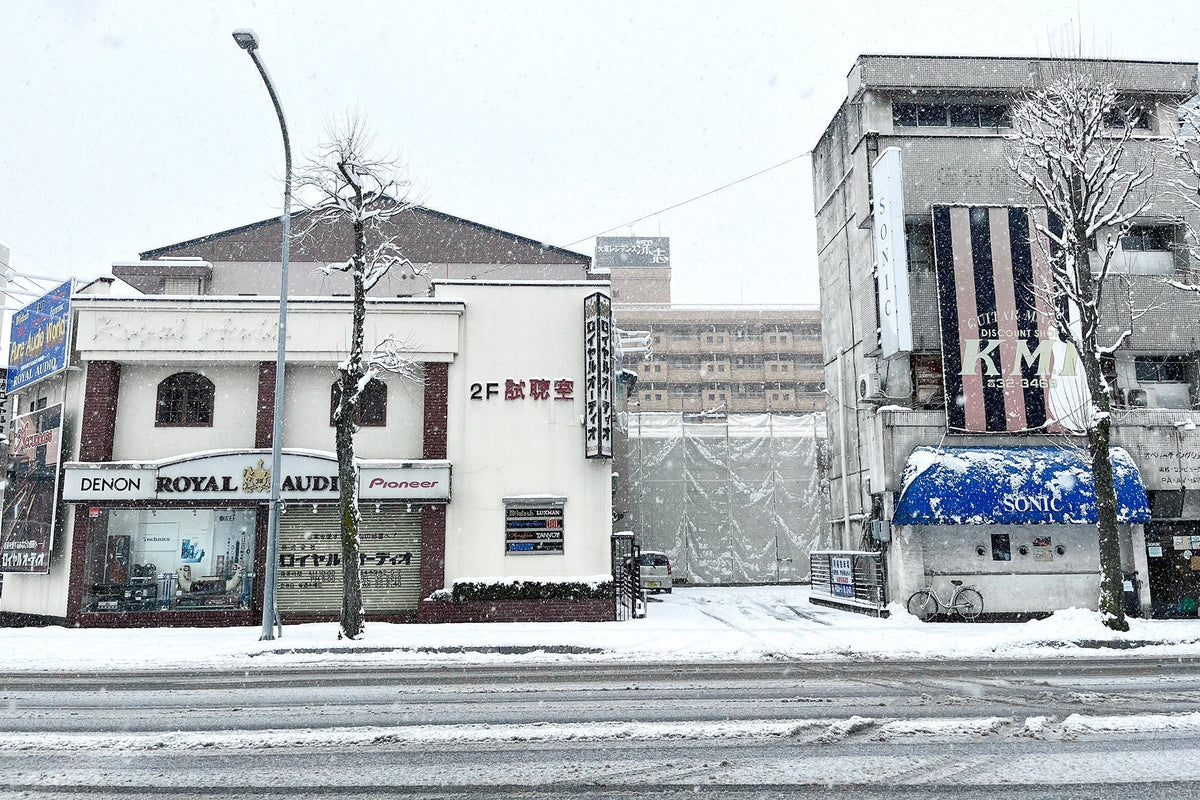
After exiting Matsumoto Station via the Castle Gate and walking straight east along the station-front main street, with snow falling steadily, I saw a building on my right labeled "Royal Audio" and "2F Listening Room." This building had nothing to do with the Architecture and Art Festival, but I still remember how my heart raced at the sight of its atmosphere, which felt as if time had stood still. *As of 2026, this building still exists but has been renovated and is occupied by different tenants.
On a whim, I decided to turn down a side street. When I eventually reached Nakamachi Street, I was captivated by the white and black contrast of the earthen-walled storehouses (dozo-zukuri) under the winter’s white sky. With the warehouse district where the 400-year history of the castle town can be felt, and the many modern buildings I was about to visit, I had a feeling this would be a wonderful trip.
I stayed at the Matsumoto Hotel Kagetsu, a long-established hotel where the spirit of Matsumoto's folk art (mingei) lives on. The calm guest rooms, furnished with Matsumoto folk furniture, also featured works by Samiro Yunoki. Perhaps because there were many cancellations due to the heavy snow, my room was upgraded, and I spent a luxurious night alone enjoying Matsumoto.
The next day was clear from the morning. From the window at Kagetsu, I was able to view the "Morgenrot"—the North Alps' Mt. Jonen tinted in pink. After checking out, I walked toward the Former Kaichi School, glancing at a building shaped like a pleasure boat marked "Kakifune," and saw the keep of the snow-covered Matsumoto Castle shining brilliantly.
Right next to the Former Kaichi School is the Former Priest’s House, which was once used as a residence for missionaries of the Matsumoto Catholic Church. Video works were being screened there, and I savored a moment where the time that had once flowed through the small building intersected with the time inside the film. The green paint used on the window frames reminded me of the interior of the Bluff 18th Building in Yokohama, and I wondered if this was a unique color palette for Western-style architecture.
After leaving my luggage at the station, I passed through Nakamachi, where the snow was beginning to melt, and fueled up with a large muffin from "amijok." In the afternoon, I first visited an exhibition by Naoki Ishikawa held at the "Restaurant Hikariya," a Registered Tangible Cultural Property, and then toured the "Kawakami Architectural Design Office (Former Matsuoka Clinic)," another historic structure. The architectural design office, which one cannot usually enter, was open to the public during the art festival. Buildings that appear to be stone or Western-style on the front facade despite being wood construction are called "kanban kenchiku" (signboard architecture). I found its unique construction and the creative use of spaces like the former "reception" area, which were remnants of its time as a clinic, endlessly fascinating. After visiting exhibitions at the Agata-no-Mori Theater (formerly Piccadilly Hall), Agata-no-Mori Cinema, and the NTT East Matsumoto Daimon-cho Building, I enjoyed a slow cup of coffee at "Shioribi" and concluded my trip to Matsumoto.
At the time, I never imagined that I would be living there two years later. But perhaps the many retro buildings left in the city, and the charm of the city that I was able to feel through them, gave me the push to decide to move to Matsumoto.
A city where old buildings are not torn down but properly utilized makes one feel the presence of people who cherish and love them. A city that preserves buildings—which require time and money to maintain and manage—also offers a glimpse of respect for the history and the people those buildings have watched over, and it somehow feels like a good place to be. That impression has not changed in the two years since I moved here.
A book that captures this love for Matsumoto's architecture was published in May. "Matsumoto Retro Architecture Walk" is a guidebook that introduces existing retro architecture in Matsumoto City and its surroundings, incorporating records of their history and the people involved. One of the authors, who writes that "architecture is the memory of the city itself," is Fumika Yoneyama, a first-class architect who runs her own office after working for the Matsumoto city government and has long served as a city-walk guide. She introduces almost every retro building one can see in Matsumoto. (I also feel a sense of affinity for the fact that we share the same name.)
This year, the "Matsumoto Architecture and Art Festival 2026" will be held as the main program for "East Asia City of Culture 2026 Matsumoto" (Dates: November 3 – December 13). It seems to have a slightly different purpose than the first edition, but I am very much looking forward to the collaboration between East Asian cities and a major event where you can enjoy architecture and art throughout the city of Matsumoto.
Whether you study up before visiting, dig deeper into buildings that catch your eye while you're there, or rediscover the charm of the buildings you see every day after you've moved in, this book—overflowing with love for architecture and Matsumoto—is highly recommended as a companion for your visit to Matsumoto.
*Aside*
I also own "A Journey Around Yokohama's Fine Architecture," also published by X-Knowledge, and the author Riku Onda, who is one of the contributors, says that the roots of her love for architecture lie in Matsumoto, where she spent her childhood. There is no doubt that both Yokohama and Matsumoto are charming cities for architecture lovers. Regarding Yokohama, I felt sad during the 16 years I lived there as my favorite retro buildings were torn down one after another (some even had opposition movements where many citizens, myself included, gathered signatures). I believe whether the distinctive buildings of Matsumoto will remain depends on the consciousness and values of each person living there. While not everything from the past is wonderful, buildings are living witnesses to time and history that, once destroyed, can never be brought back. I want to cherish the richness of the fact that they are preserved.

Artwork: Kasumi Wakai (Book Design)
Format: book, soft cover
product no.(or ISBN) : 9784767835624
_

|
Text & Photography / Fumika Arasawa Designer |
_
WALLFLOWER CATALOGUE
Designer Fumika Arasawa introduces one piece of artwork that stirs the design heart in each issue.
Updated once every month (on the first day of that month's first solar term).
Bookmarks and archives can be found here.
